


InstaPro Explains Certified Copies for Egyptians in the UAE
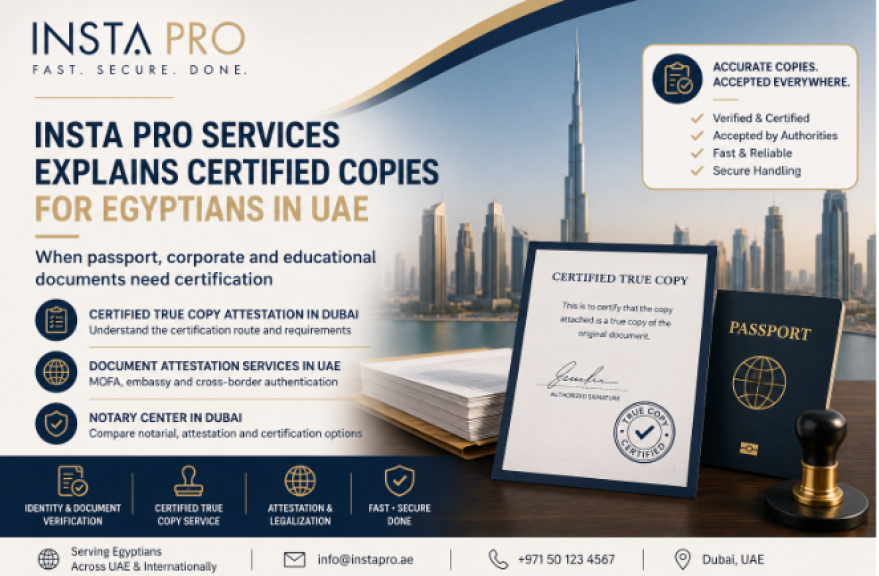
What a certified true copy actually confirms
A certified true copy is a verified reproduction of an original document. The certifying authority confirms that the copy presented matches the original shown at the time of certification. This service is commonly requested for immigration, banking, company formation, employment, education and international compliance. It does not prove that every statement in the original document is true; it confirms that the copy is faithful to the original. Egyptian residents frequently encounter this requirement when dealing with UAE banks, employers, universities or immigration files. For broader document and corporate support, applicants may also review InstaPro.
Individuals preparing files for banks, universities or foreign authorities often look for certified true copy attestation in dubai to understand who can certify the document and whether additional attestation will be required.
Documents commonly certified in the UAE
Passports, Emirates IDs, academic certificates, employment letters, trade licences, shareholder documents, board resolutions and powers of attorney are among the records frequently submitted for true-copy certification. The receiving institution usually decides which documents must be certified and how recent the certification should be. Where the file will be used across borders, applicants can also review document attestation services in the UAE before deciding whether further authentication is required.
Passport files deserve particular attention because many institutions request a certified true copy of passport in the UAE rather than a simple scan or photocopy.
Passport and identity-document checks
The original passport should be valid and undamaged. The biographical page must be fully visible, and some authorities may request copies of visa, residency or signature pages. Cropped scans, glare and inconsistent names are common reasons a certified copy is not accepted later.
When the applicant does not work comfortably in Arabic or English, multilingual professional support can be useful for understanding the legal purpose of the certification and the documents required for a broader transaction.
Certified copy, notarization and attestation
These terms are related but not interchangeable. A certified true copy confirms that a copy matches the original. Notarization may confirm signatures, declarations or legal execution. Attestation validates official seals for use before another authority or in another country. A document may require one, two or all three processes depending on its destination.
Educational and employment documents
Universities, licensing bodies and employers may request certified copies of degrees, transcripts, professional certificates or experience letters. When the documents were issued outside the UAE, certification alone may not be enough. The original may first need attestation from the issuing country and the UAE authorities.
Corporate records and compliance files
Banks and regulators often ask companies for certified copies of trade licences, certificates of incorporation, constitutional documents and authorised signatory records. Each page may need to be clear and complete. Outdated licences or documents that do not show current ownership can delay account opening or compliance reviews.
Foreign-language documents
A foreign-language document may need legal translation before or after certification. The correct order depends on whether the receiving authority wants the original, a certified copy, a translated copy or an attested translation. Applicants should not assume that a bilingual stamp automatically satisfies every institution.
Dubai, Abu Dhabi and Sharjah
True-copy services are available across the main emirates, but the accepted provider and procedure can depend on the recipient. A certification accepted by one private institution may not be sufficient for a government department or foreign embassy. The applicant should therefore identify the exact standard before arranging the service.
Avoid certifying more documents than necessary
The receiving institution should provide a clear checklist stating which pages, dates and certification wording it requires. Following that checklist saves cost and reduces the risk of a second submission. A carefully prepared certified-copy package should be legible, consistent and suitable for the transaction it is intended to support.
How institutions assess a certified-copy package
Receiving institutions look for more than a visible stamp. They may check the certifier’s authority, signature, date, wording and contact details. Some require every page to be certified, while others accept a certification covering a complete attached set. The applicant should not separate or rearrange certified pages after completion.
Digital copies and electronic certification
Electronic workflows are increasingly common, but a digitally submitted copy is not automatically a certified true copy. The receiving institution may require a digitally signed certification, a verification code or an original paper version. Applicants should confirm the accepted format before scanning or uploading documents.
Validity and recent certification
A certified copy does not normally cause the underlying document to remain valid beyond its own expiry date. Institutions may also request recently certified copies for compliance purposes. A passport copy certified months earlier can be rejected if the passport has been renewed or the institution requires certification within a specific period.
International use and further legalisation
When a certified copy is sent abroad, the certifier’s signature or seal may need additional attestation. The destination country might require embassy legalisation, an apostille-equivalent process or local verification after arrival. The exact chain depends on the issuing and receiving jurisdictions.
Prepare only what the recipient requests
Applicants often certify complete files when only a few pages are needed. This increases cost and creates more opportunities for inconsistency. A written checklist from the bank, university, employer or authority should determine the number of copies, pages, language, certification date and any later attestation steps.